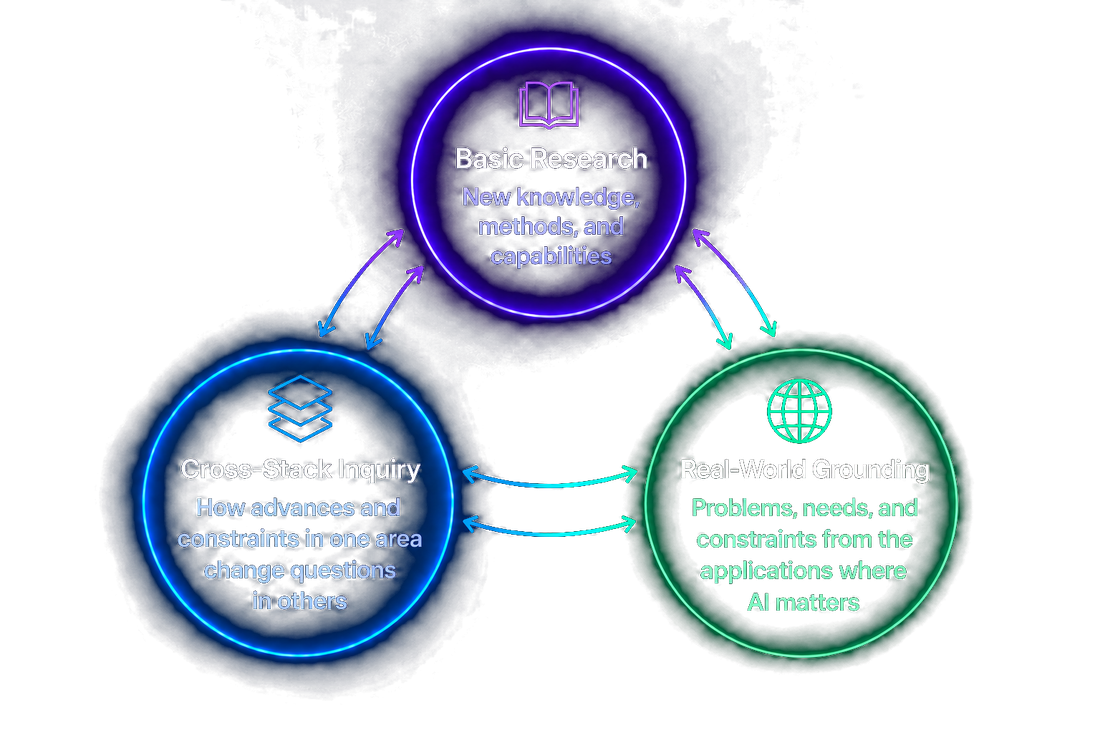
Deep Expertise. Broader Perspective. Greater Ambition. ASCENT brings fundamental research, real-world needs, and perspectives across the AI stack
Basic Research New knowledge, methods, and capabilities.
Cross-Stack Inquiry How advances and constraints in one area change questions in others.
Real-World Grounding Problems, needs, and constraints from the applications where AI matters.
New questions and perspectives moves between Basic Research and Cross-Stack Inquiry. Constraints and needs moves between Basic Research and Real-World Grounding. New possibilities and solutions moves between Cross-Stack Inquiry and Real-World Grounding.
Questions we’re exploring together. Showing question 1 of 8: How do we build effective AI when the data we need are scarce, costly, or incomplete?
← How do we build effective AI when the data we need are scarce, costly, or incomplete?
The data AI needs are not always abundant or easy to obtain. Important populations may be underrepresented, scientific observations may be sparse, rare events may provide few examples, and high-quality measurements or labels can require substantial time, expertise, access, or expense. The challenge is therefore two-sided: we need methods that learn effectively from the data available while also helping determine what additional data would be most valuable to collect, from where or whom, and how often. ASCENT brings together perspectives in data acquisition and curation, data-efficient learning, representation, autonomous sensing, and AI infrastructure to explore how learning and data collection can inform one another. Learn more → How do we design AI so people and AI can accomplish more together than either could alone?
Effective human-AI collaboration requires more than adding a person to an AI workflow. Systems need mechanisms for deciding what each participant should contribute, learning from people, communicating relevant information and limitations, coordinating decisions and actions, and adapting roles as the task or circumstances change. The open question is how to design the combined human-AI system so complementary capabilities actually produce better outcomes rather than additional friction or misplaced trust. ASCENT brings together perspectives in collaborative AI, human-robot interaction, human-machine task allocation, explainability, shared autonomy, and embodied intelligence to explore how people and AI can work together effectively. Learn more → What infrastructure do we need to build for the next generation of AI?
Changes in models and applications continually create new demands on the systems underneath them: how data are collected, stored, and moved; how training is distributed; how models and agents are served; and where computation happens. Emerging applications can introduce very different requirements, from massive centralized training to AI operating with data and computation distributed across satellites, robots, and other edge systems. Infrastructure is therefore not merely a fixed substrate for AI. Its capabilities and limitations can determine which models and applications are practical to build at all. ASCENT brings together perspectives in ML systems, data infrastructure, training and inference, geospatial AI, satellite systems, edge computing, and physical AI to explore how emerging AI capabilities and applications should shape the infrastructure that supports them. Learn more → How do we create representations that support diverse downstream purposes and guide action?
AI systems transform observations into representations that determine what information remains available for everything that follows. Representations intended for broad reuse must preserve information relevant to many downstream tasks and users, while systems that operate in the physical world need representations that support reasoning, planning, and action. The open problem is how downstream purposes should influence what information gets represented in the first place without reducing representations to a single task. ASCENT brings together perspectives in representation learning, geospatial and scientific ML, perception, and autonomous systems to explore the relationship between what AI represents and what it can ultimately discover or do. Learn more → How do we build AI that understands what people mean, need, and intend?
People rarely communicate everything an AI system needs to know explicitly. Meaning can be ambiguous or nonliteral, needs depend on context, and intent may be expressed through language, images, behavior, gaze, motion, or other implicit signals. Building systems that respond appropriately therefore requires more than recognizing inputs: AI must represent meaning, resolve or acknowledge ambiguity, infer goals without overreaching, and use context appropriately. ASCENT brings together perspectives in computational semantics, multimodal understanding, ambiguity, human-robot interaction, and intent inference to explore how AI can better interpret people. Learn more → How do we build AI that can recognize and respond appropriately to its own uncertainty and limitations?
AI systems increasingly operate in situations where their predictions may be unreliable, observations incomplete, or learned capabilities poorly matched to the problem at hand. The research challenge is not only recognizing when an AI system is likely to fail, but determining what should happen next: gather more information, explain its uncertainty, change its behavior, defer to a person, or avoid acting altogether. Doing this well can require advances in prediction, reasoning, verification, evaluation, perception, and mechanisms for deciding when responsibility should shift between AI and people. ASCENT brings together perspectives in trustworthy and neuro-symbolic AI, human-machine task allocation, explainability, autonomous systems, and perception to explore how AI systems can recognize their limits and respond appropriately. Learn more → How do we design AI to learn across heterogeneous sources of information, enabling new capabilities and discoveries?
The information available to AI increasingly comes from sources that differ in modality, scale, resolution, coverage, and quality. Images and language can provide complementary context; different sensors reveal different aspects of a physical environment; and scientific observations may span locations, timescales, and measurement systems. The challenge is not simply combining more data, but designing representations and learning methods that identify which information is complementary, preserve what matters across sources, and make those combined signals useful downstream. ASCENT brings together perspectives in multimodal learning, geospatial machine learning, multi-sensor perception, representation learning, and data infrastructure to explore how learning across heterogeneous information can enable new capabilities and discoveries. Learn more → How do we build AI when real-world settings constrain compute, sensing, communication, or other aspects of the system?
AI deployed outside ideal computing environments may encounter a constraint in any one part of the system: limited compute or power, imperfect sensing, intermittent communication, latency requirements, or other physical and operational limitations. Those constraints are not necessarily downstream implementation details; a limitation in one place can change which models are practical, where computation should happen, how sensing should be designed, or how performance should be evaluated. The open research problem is how constraints should propagate back through the design of the larger AI system. ASCENT brings together perspectives in AI infrastructure, edge computing, perception, field robotics, embodied AI, and autonomous systems to explore these cross-stack tradeoffs. Learn more → →